
{{ p.title }}
{{ b.text }}
{{ g.text }} {{ g.text }} {{ g.text }}
| {{ c.v }} |
|---|
{{ b.note }}
{{ p.kfImg.note }}
Duke University reports USD 14.30 billion in duke university endowment for June 30, 2026. Balance source
Duke's FY2026 snapshot reports an endowment of approximately $14.3 billion spread across more than 6,600 funds. Its Long Term Pool returned 19.3% for the year ended June 30, 2026 and 11.3% annually over ten years. Each endowed fund owns units in that pool. About 23% of the endowment is designated for financial aid and 21% for specific faculty positions. Official report
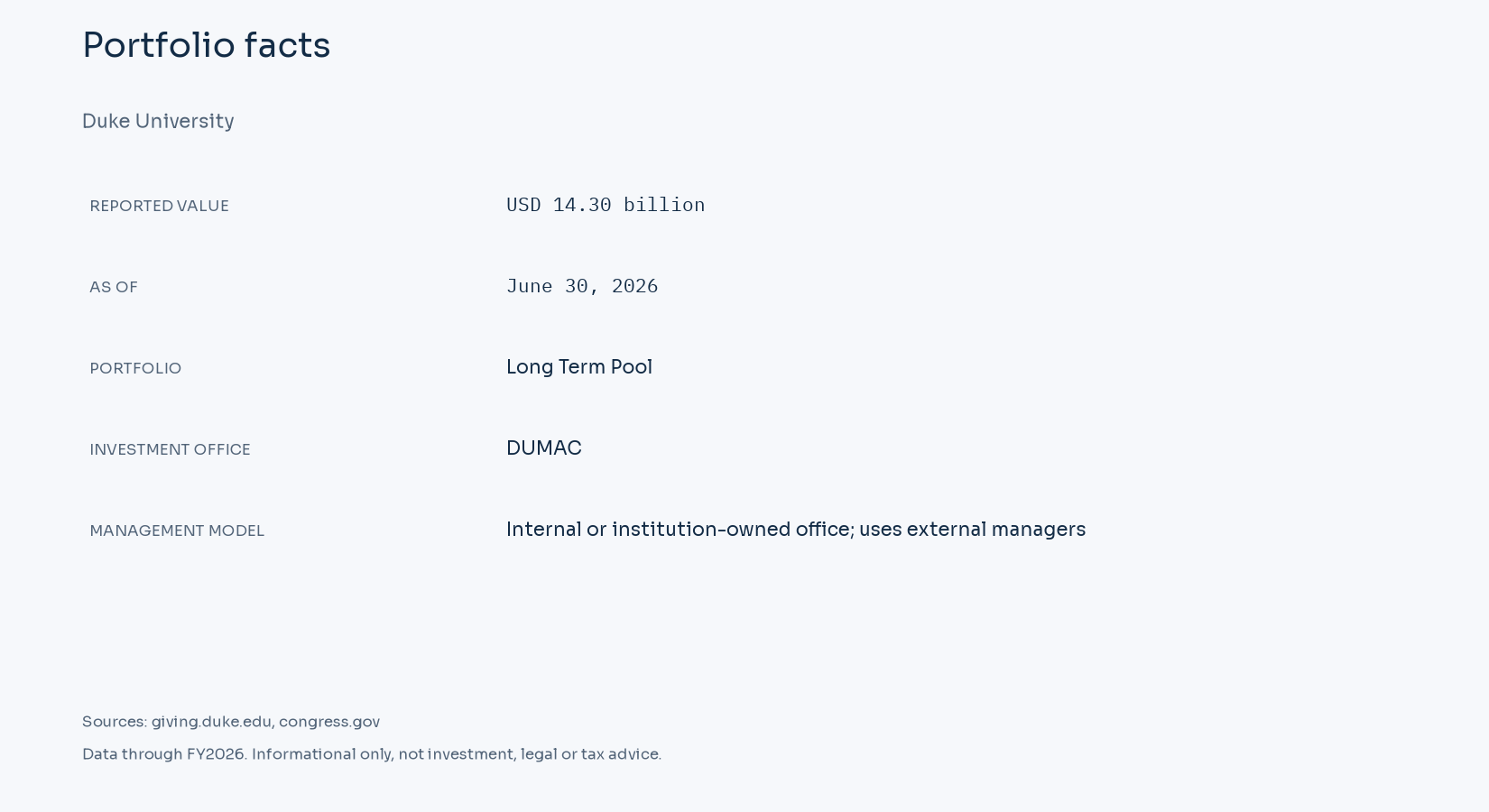
The latest balance is labelled duke university endowment and is dated June 30, 2026. The return series identifies the portfolio as Long Term Pool. The historical survey below retains the respondent scope reported to NACUBO. A pooled investment vehicle can include working capital, reserves or assets for associated organizations alongside endowed gifts. Each participating fund owns its own economic interest in that vehicle. The pool's market value, the institution's endowment balance and the investment manager's corporate assets describe different quantities. Official report
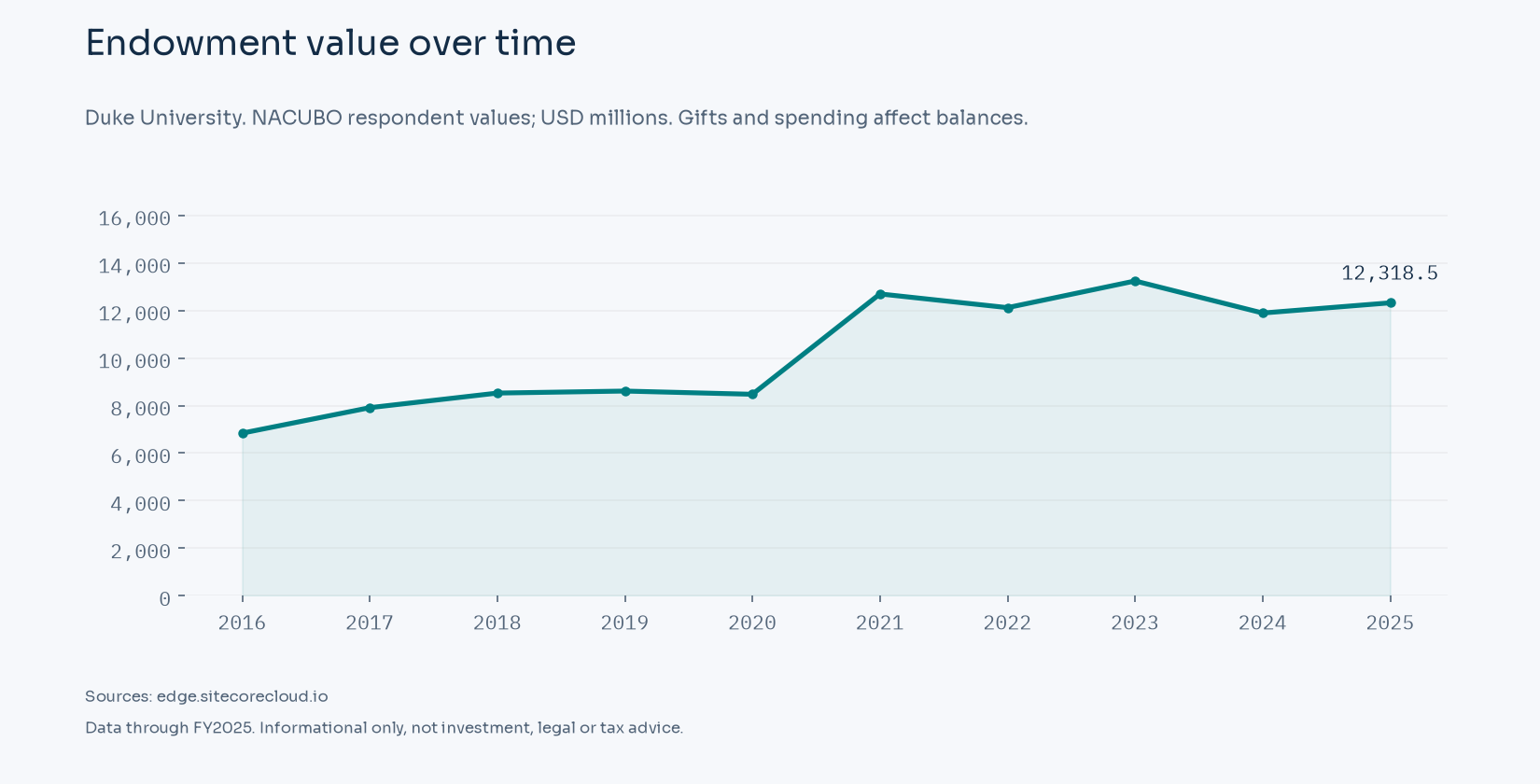
| Fiscal year | Survey endowment, USD millions |
|---|---|
| FY2016 | 6,839.8 |
| FY2017 | 7,911.2 |
| FY2018 | 8,524.8 |
| FY2019 | 8,609.0 |
| FY2020 | 8,474.1 |
| FY2021 | 12,692.5 |
| FY2022 | 12,116.3 |
| FY2023 | 13,238.0 |
| FY2024 | 11,890.0 |
| FY2025 | 12,318.5 |
Across the reported FY2016 to FY2025 observations, the survey balance changed by USD 5,478.7 million (80.1%). This is balance growth; it includes the effect of new capital and distributions. NACUBO historical values FY2025 respondent table
| Portfolio | Period end | Horizon | Reported return |
|---|---|---|---|
| Long Term Pool | June 30, 2026 | 1 year | 19.3% |
| Long Term Pool | June 30, 2026 | 10 years, annualized | 11.3% |
The 1-year result is 19.3%, while the 10-year result is 11.3% annually. The trailing periods share the same end date and overlap; their percentages are not added together. A long-term annualized return describes compound growth over the full period. The year-end asset balance also reflects money entering or leaving the portfolio. Return series
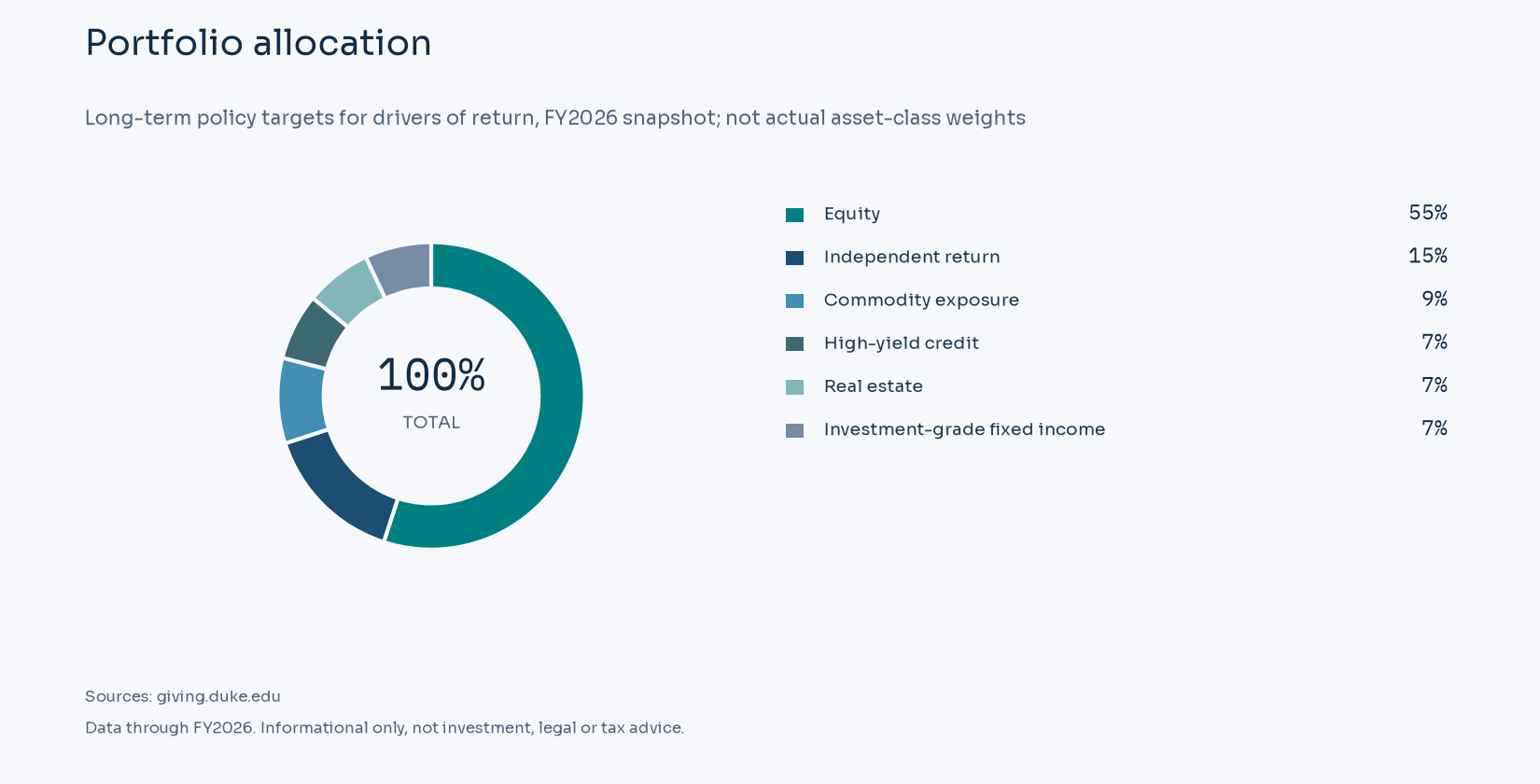
| Published category | Weight |
|---|---|
| Equity | 55% |
| Independent return | 15% |
| Commodity exposure | 9% |
| High-yield credit | 7% |
| Real estate | 7% |
| Investment-grade fixed income | 7% |
Long-term policy targets for drivers of return, FY2026 snapshot; not actual asset-class weights. Allocation report
These weights are policy targets. Actual exposures can move with markets, commitments and rebalancing. The chart retains the portfolio and target labels used in the report.
Duke combines spending and investment policies to deliver stable operating support and preserve future purchasing power. The Long Term Pool's long-term investment objective is a real return of at least 5% net of fees. That is an investment objective, not an endowment spending rate. The university's snapshot separates the purpose of endowed funds from the pool's investment exposures. Spending disclosure
A distribution is money made available for the fund's designated use. A policy rate uses the averaging base defined by the institution. Dividing the distribution by the latest closing balance would create another measure, so the published formula and the reported dollar amount retain their own labels. Distribution basis
DUMAC is a professionally staffed investment organization controlled by Duke University and governed by an 11-member board. It principally invests through advisory firms and partnerships. It also manages retirement assets, health-system investments, working capital and assets of The Duke Endowment. The Duke Endowment is a separate charitable trust; its assets are excluded from the university endowment balance. Investment governance
Public Law 119-21 changed IRC 4968 for tax years beginning after December 31, 2025. An applicable institution must have at least 3,000 tuition-paying students in the preceding tax year, with more than half located in the United States. Its student-adjusted endowment must be at least $500,000. The rate is 1.4% from $500,000 through $750,000 per student, 4% above $750,000 through $2 million, and 8% above $2 million. Enacted law, Section 70415
The tax applies to net investment income. Student-adjusted endowment uses the prior year's fair value of assets other than those used directly for exempt purposes, with statutory student-count and related-organization rules. Dividing the headline endowment by a fall enrollment number can give a different result. A rate on investment income also differs from a spending-policy percentage applied to average assets.
The FY2025 NACUBO respondent value of USD 12,318.5 million places this reporting entity in the Over $5B band. The published group contains 30 respondents. Its average annualized five-year return was 11.4%, its ten-year average was 8.9%, and its average effective spending rate was 5.0%. These are survey averages for FY2025. Respondent counts Average net returns Spending-rate table
| NCSE measure | FY2025 average |
|---|---|
| One-year net return | 11.8% |
| Five-year annualized net return | 11.4% |
| Ten-year annualized net return | 8.9% |
| Effective spending rate | 5.0% |
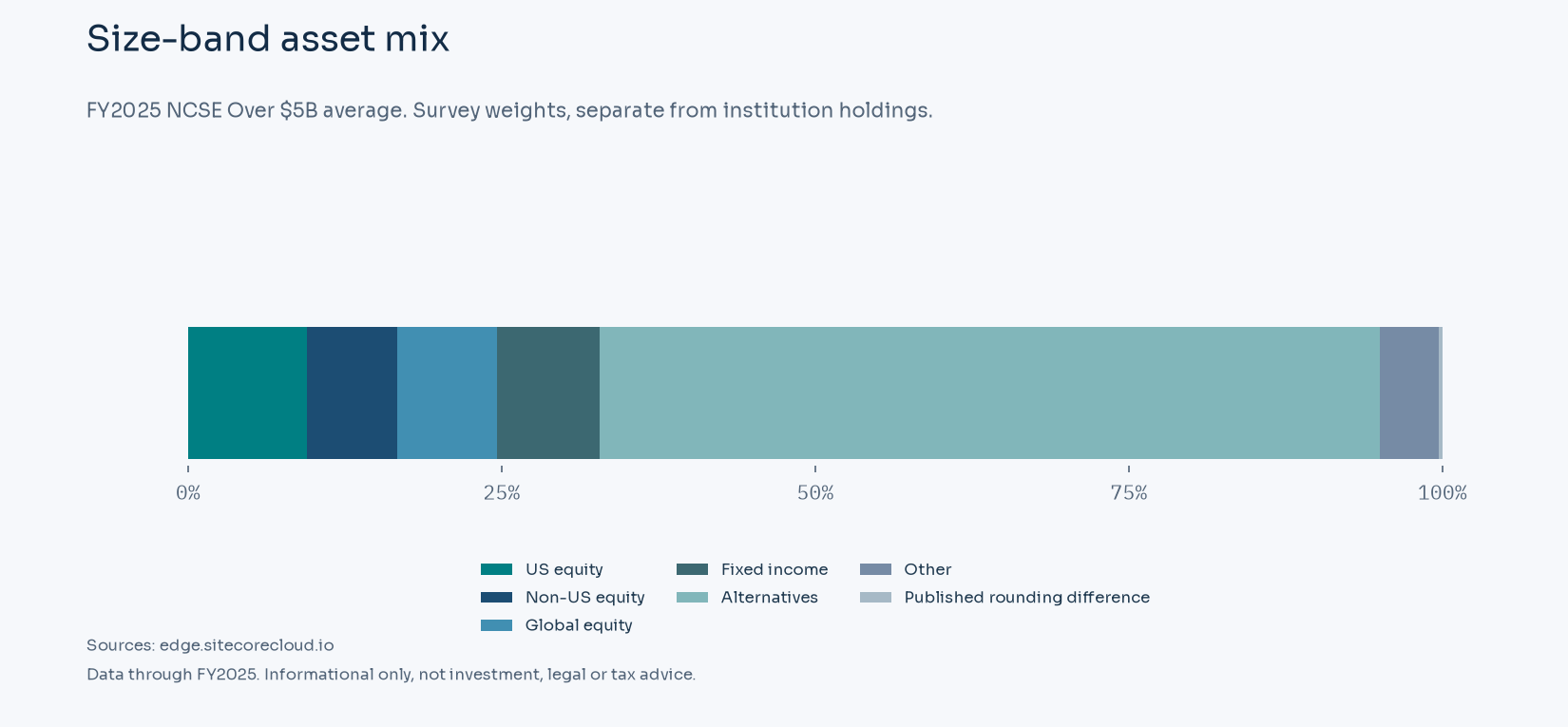
NCSE returns are net of external management fees and expenses for periods ended June 30, 2025. A portfolio reported on another cost convention or fiscal-year end describes a different result. Survey allocation definitions
The official investment report supplies the portfolio figures and measurement dates on this page. The institution or related reporting entity also has a public nonprofit filing record. Tax-return assets and expenses cover that legal filer and can be broader than its endowment. Nonprofit filing record

The #1 most in-depth guide to endowment funds with in-depth profiles, infographics, resources, and research
I started Family Office Club 19 years ago. I would rather build a real relationship than sell you something. I am not a broker. I am not a bank. I do not charge for anything on this site.
Endowments are some of the most studied investors in the world, and the numbers are scattered across financial reports, press releases and student newspapers. This site puts each endowment's figures in one place, from its own reports first, names every source, and says plainly when a number has not been published.
We run 16 in-person events a year, 4 Super Summits and 12 masterminds, in NYC, Fort Lauderdale, Dallas, Los Angeles and Beverly Hills. 300 of them over 19 years.
"The Family Office Club is unique as a community. The thing I admire about you is that you started with your family, making that a priority."
Todd Heiner · centimillionaire, co-founder of Express Locations
Each fact names its source and its date. When two sources disagree, we show both. When an endowment has not published a number, we say so.
{{ dirIntro }}
| {{ r.type }} | {{ r.loc }} | {{ r.size }} | {{ r.fy }} |
Size is the tracked endowment market value in USD, mostly from the NACUBO-Commonfund Study of Endowments FY2025 public table. Linked names open a full profile with the institution's own latest figures, dates and currency.
| {{ c.v }} |
|---|
| {{ c.v }} |
|---|
| {{ c.v }} |
|---|
| {{ c.v }} |
|---|
{{ guidesIntro }}
This page does not exist or has moved.
Ranked from published profiles only, using each endowment's latest reported fiscal year. The basis and date sit next to every number. {{ stats.queued }} endowments are still in research and will be added as their profiles publish.
| # | Endowment | Country | Value | Return | Fiscal year and date |
|---|---|---|---|---|---|
| {{ r.rank }} | {{ r.name }} | {{ r.country }} | {{ r.value }} | {{ r.ret }} | {{ r.fy }}, {{ r.asOf }} |
Practical guides for raising from, working with and running endowments. Each one is being written now and will publish here, free.
Tell me what you are raising for. I will tell you which endowments look like a fit, and which rooms are worth being in. I read these myself.
Correct it or claim it. It is free. Send the page, the change and a public source, and we will update it and note the date.
For board members, investment committee members, donors, students and journalists. Every profile shows value, return, spending and allocation with the fiscal year and source next to each figure.
Each fact names its source and its date. We start with the institution's own financial report, investment office report and press release, then official filings, then third-party reporting. Figures are tied to a fiscal year, because most endowments report once a year. When two sources disagree, we show both. When an endowment has not published a number, we say so rather than estimate it silently.
To report an error or ask for a change or removal, email Richard@Endowments.com or text (808) 600-9260.
{{ a.a }}
16 in-person events a year, 4 Super Summits and 12 masterminds, plus monthly webinars. Run by Family Office Club.

Endowments.com is a research resource on university, college and foundation endowments. It profiles 775 endowments, including university, college, foundation and hospital endowments, built from each institution's own reports and public filings, and runs the Endowments by Size Band benchmark study. Every figure carries its source and date.
I started Family Office Club 19 years ago at 26, as my 12th startup and the first one that worked. All three of my daughters are in the business with me now. My father raised $1 billion for non-profits before I ever started, so I grew up watching this.
Since then: 300+ in-person events, 1,500 investors on stage, 250+ family offices created or formalized, 46 transactions off my own balance sheet, and CIO of a $180M single family office.
I am not a broker. I am not a bank. I do not charge for anything on this site. I built it because endowment figures are spread across hundreds of reports and press releases, and few places put them side by side with sources.
Text or WhatsApp me at (808) 600-9260, or email Richard@Endowments.com.
I'm Richard C. Wilson. I started Family Office Club 19 years ago. I read the messages that come in through this site myself. Text or WhatsApp me at (808) 600-9260, or email Richard@Endowments.com. Thank you.
This page is for general information only and is not investment, tax or legal advice. Figures come from the public sources listed and may have changed.